We hope that reader will gain an increased appreciation of the need for more conservation measure in order to protect the beautiful creatures that inhabit the earth. Our philosophy is that the more we learn about animals, the more we respect them and take better care of them. That is why we update this blog with new animals, We encourage you to syndicate our content by adding "animal of the day" to your own blog! (read more)
About us
Our mission is to get people excited about animals and their welfare by writing articles on these animals. We encourage people to comment on posts and share with others. Don't forget to subscribe to our feed.
Pere David's deer (Elaphurus davidianus) only is known now in captivity, in the wild they were extinct in the 19th century. However, it has been reintroduced in Nan Haizi Milu Park, Beijing and Dafeng Reserve, Jiangsu Province in the 1980's. After the publication of his discovery, by father Armand David, working as a French missionary in China, the animals soon were extinct in the wild. The last remaining herd was in a preserve of the emperor and was eaten by Western and Japanese troops during the Boxer Rebellion. Before that, a small number of Père David's Deer was exported to England, were they were bred further. All living Pere David's deer come from this single herd. It is now classified as 'critically endangered'. The Père David's Deer is very fond of water, unlike other deer species... The Chinese gave it the name "sze pu shiang" which means "none of the four", as it has a tail of a donkey, a neck like a camel, antlers of a deer, and hooves of a cow, but it doesn't look like any of them...
The Swift Fox (Vulpes velox) lives in Saskatchewan and Alberta in Canada and the western grasslands of North America. It is indeed rather swift, reaching speeds of more than 50 kilometers per hour. The Swift Fox is severely endangered and scientists disagree whether the Swift fox and the Kit Fox are different species. The Kit fox (Vulpes macrotis) is slightly larger than the Swift Fox, and the Swift Fox has a narrower snout. Molecular systematics (the study of both DNA) support that the two species are different. They are primary nocturnal and live in pairs. Swift foxes choose their partner for life. The pups are born in underground dens in which they remain for about one month. The first 15 days their eyes are closed, so they rely totally on their mother for food and protection.
You can help spreading the word about this animal by liking it on facebook
The Giant forest hog (Hylochoerus meinertzhageni) is the largest pig of the 16 pig species (family Suidae) in the world. The length of adults ranges from 130-210 cm, their height from 75-110 cm and they can weigh between 180-275 kg. They live in scattered populations in the rainforests of West and Central Africa. They are shy, nocturnal creatures, which feed on grass and do not dig with their snouts for food like other wild pigs. 'Wallowing', rolling through the mud, is a favourite activity of them. The male is responsible for defending the group and does so very aggressively. Giant forest hogs, like other pigs practice 'coprophagy', which means they consume feces of other animals, because they contain amounts of semi-digested food. Their main predators are the leopard and the hyena.
Interesting fact: In the Congo, eating a giant forest hog is believed to bring misfortune.
Picture of the Giant forest hog by S. Fimpel, licensed under GFDL
You can help spreading the word about this animal by liking it on facebook
The moose (Alces alces) lives on the Northern hemisphere in forested areas, from Alaska, Canada in North America and from Finland to Eastern Russia and China (se


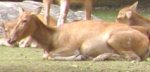 Pere David's deer (Elaphurus davidianus) only is known now in captivity, in the wild they were extinct in the 19th century. However, it has been reintroduced in Nan Haizi Milu Park, Beijing and Dafeng Reserve, Jiangsu Province in the 1980's. After the publication of his discovery, by father Armand David, working as a French missionary in China, the animals soon were extinct in the wild. The last remaining herd was in a preserve of the emperor and was eaten by Western and Japanese troops during the Boxer Rebellion. Before that, a small number of Père David's Deer was exported to England, were they were bred further. All living Pere David's deer come from this single herd. It is now classified as 'critically endangered'. The Père David's Deer is very fond of water, unlike other deer species... The Chinese gave it the name "sze pu shiang" which means "none of the four", as it has a tail of a donkey, a neck like a camel, antlers of a deer, and hooves of a cow, but it doesn't look like any of them...
  The
The 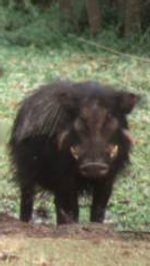 The
The 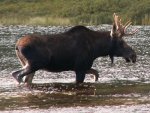 The
The