Thursday 28 October 2010
Soemmerring's Gazelle - Once the Most Abundant Gazelle, Now Nearing Endangered Status
The
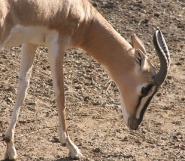
Soemmerring's Gazelle (
Gazella soemmerringii) were once the most abundant Gazelle on the African continent, moving about in large herds of several hundred. Today, they can be found in small groups between 5 and 20, often intermingling with herds of hartebeest, oryx, and domesticated camels. Both CITES and IUCN have listed the Soemmerring's Gazelle as a vulnerable species due to a 30% decline over 3 generations (21 years). Current estimates are that the decline will continue at a rate of about 10% per year. The likeliest cause of the decline is the loss of habitat to domestic grazing, hunting, and regional political unrest.
Soemmerring's Gazelle have a tawny brown coat interrupted by patches of white around the head, covering the belly, inside the legs, and over the rear end. Three black stripes extend from the top of the skull to the nose, with one covering each eye and the other centered on the bridge of the nose. The horns grow back over the skull in a lyre shape, are ridged, and can grow up to 22 inches (58 cm) long. Adults can measure 4-5 feet (120-150 cm) in length, 2.3-3 feet (85-92 cm) high at the shoulders, and weigh from 70-100 pounds (35-45 kg).
The Soemmerring's Gazelle inhabit lightly forested steppes and savannas on the Horn of Africa, from Eastern Sudan through Ethiopia, Eritrea, Djibouti, and Somalia. Food sources include acacia, brush leaves, grass, and herbs, and are known to migrate with the rainy season to ensure sufficient food is available. As a large herbivore they are food sources for several large predators, including the cheetah,
lion, leopard, hyena, Cape hunting dog, and python. The primary defensive measure against predators is the ability to run and leap through the air for considerable distance at high speeds, up to 50 mph (80 kph).
Although the horns can be used for defense as well, most of the wear and tear visible on the horns of older males is from territorial disputes with other males. During the period from September to November males will mate with receptive females while walking together, with the male continuing to walk after mounting with his two hind legs. Gestation is 199 days, or about 6-1/2 months, so that the birth of a single infant occurs during the rainy season when food and water is plentiful. The young are weaned after 6 months, reach sexual maturity in 1.5 years, and live for up to 14 years.
Picture of the Soemmerring's Gazelle by , licensed under
GFDL
You can help spreading the word about this animal by liking it on facebook
Permanent Link
Tuesday 26 October 2010
Lyle's Flying Fox - Buddhist Refugees
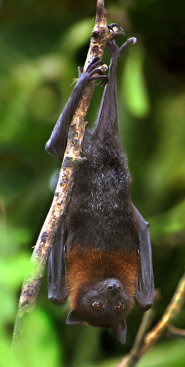 Lyle%u2019s Flying Fox
 (
Pteropus lylei) belongs to the large family of mammalian old world fruit bats or flying foxes. The Spanish name is Zorro Valador De Lyle. As the common name suggests fruit bats live on nectar, pollen, blossoms, and fruit, and for this reason their habitats are limited to tropical and subtropical regions of the world. Old world fruit bats are the largest bats in the world, with wing spans up to 6 feet (1.8 meters) and weighing as much as 2.2 pounds (1.5 kg). By comparison, the size of Lyle’s flying foxes is about mid-sized within the fruit bat family.
Lyle’s flying foxes will colonize trees in large groups, where they nest and suckle their young during the day. At night they depart to forage for food and have been known to travel 40 miles away to find food. Rather than using echolocation as their insectivore cousins do, fruit bats rely on well-developed visual and olfactory senses.
The habitat of Lyle’s flying foxes is limited to Thailand, Cambodia, Viet Nam, and the Yunnan Province of China. Even though little is known about populations within China, Lyle’s flying foxes have been listed by IUCN as vulnerable or one step away from being considered endangered. Until recent hunting restrictions were put into place, fruit bats were considered a delicacy and were hunted legally. Hunting still occurs in some places, but habitat degradation and destruction has also contributed to the 30% population decline over the past 15 years (three generations). In Thailand and Cambodia, Lyle’s flying foxes are considered pests and are not protected except on temple grounds. For this reason, large, noisy colonies of Lyle’s flying foxes can be found colonizing the trees over some Buddhist temples in Cambodia and Thailand. Up to 11 colonies are known to exist in Thailand and the largest contains close to 3000 individuals.
The size of fruit bats can be truly startling when first encountered at night by strangers to tropical climes and has resulted in reports of vampire bats or flying pterodactyls, but unless you’re a fruit or flower, or smell like one, you have little to fear. Okay, a little fear is appropriate. Over the past 10 years or so several research studies have found that fruit bats, including Lyle’s flying foxes, are hosts for emerging viruses that can infect and kill livestock and
humans.
Picture of the Lyle's flying fox by Malene Thyssen, licensed under
GFDL
You can help spreading the word about this animal by liking it on facebook
Permanent Link
Monday 25 October 2010
Carp Bream - European Bottom-Dwellers
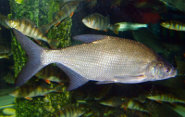
The
carp bream (
Abramis brama) is an abundant fresh-water fish commonly found at the bottoms of fresh-water canals, lakes and ponds, and on some river bottoms. Their silvery gray body is flat with a high back, and gray or black fins. Older fish may have a bronze color, especially if living in clear water. Adult carp bream can range in size from 12" to 22" (30-55 cm), and weigh between 4 and 9 pounds (2-4 kilograms).
The carp bream is an widespread European and Asian species not currently threatened. Their home range is that part of Europe north of the Pyrenees and the Alps, stretching north to the southern reaches of Scandinavia, and east through the Balkans to those areas around the Aral, the Caspian, and the Black Seas.
Carp bream live in schools on the bottoms of lakes and rivers. At night, they feed close to shore, and, during the day, on sandy bottoms in clear water. The carp bream's small protracting mouth digs through mud and silt for larvae, gastropods, and bivalves on which to feed, and nibbles on plankton and water plants. A large carp bream may even eat other small fish. Carp bream themselves are eaten by perch and pike.
Bottom overfeeding may result in food shortages, and the young fish in the school may have to resort to filter feeding with their gill rakers, catching small aquatic crustaceans called water fleas for food. But, as the carp bream reach adulthood, their gill rakers grow far enough apart that they are no longer able to feed on this abundant prey, resulting in a natural limit on the carp bream's size for those that feed mostly on water fleas.
The carp bream sexually mature around the age of three years. Spawning occurs for the carp bream April to June. Males patrol and protect territories where females lay their many eggs upon the leaves and stems of water plants. Over a week or two, the eggs develop into fish larvae, and then into slender young
fish, who detach from the plants, and live as youngsters in the "water column," the vertical length of water stretching from the surface to the bottom. The young carp bream do not become full-fledged bottom-dwellers until they are at least several months old. At that point, they achieve the body and color of the adult carp bream, and begin bottom-feeding.
You can help spreading the word about this animal by liking it on facebook
Permanent Link
Tuesday 19 October 2010
Spiny Mouse: A Fragile Tail
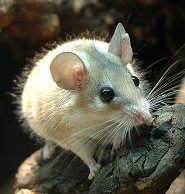
The
Spiny Mouse (
Acomys spinosissimus) is a small mammal, specifically a species of rodent of the Muridae family. It lives alone, or in small groups, inhabiting deserts, rocky terrain or dry woodlands. It is a nocturnal creature, but it does come out in early morning or late afternoon, keeping to the shadows. It is found in northeastern South Africa and the neighboring countries to the north and east: Malawi, Tanzania, Botswana, Mozambique, Zimbabwe, Zambia, and the Democratic Republic of the Congo.
The name
Acomys spinosissimus literally means "sharp-pointed mouse," a reference to the stiff thick hairs that stand out from its back. It has large black eyes and enormous rounded ears, both well-suited for nocturnal activities. Like almost all other mice of the genus Acomys, the spiny mouse has a white or creamy underbelly; unlike most other mice of the genus, its upper body is reddish-gray. On the average, a spiny mouse is 6.7" (17 cm) long, including a tail that, by itself, is about 3" (8 cm) long. The average weight of a spiny mouse is just under one ounce, or about 28 grams.
The spiny mouse's tail is covered with sparse coarse fur, and can break off rather easily. It is thought that this fragility is a defense against predators, who, upon grabbing a spiny mouse by the tail, would then be left with only the tail. Unlike a similar predator defense found in some lizards, the tail of the spiny mouse does not grow back.
The spiny mouse eats seeds, green leaves, snails, insects, and millipedes. Predators who prey on the spiny mouse are the small wild cats, the mongoose, and various
birds of prey native to South Africa, such as owls, eagles, falcons, hawks, harriers, and secretary birds.
The lifespan for a spiny mouse is anywhere from four to seven years. Spiny mice reach sexual maturity about two months after birth. Females can conceive at any time during the year. Once a female spiny mouse is pregnant, she gestates for about forty days before she gives birth. Most litters contain two or two pups, but some litters have been seen with six. Spiny mice are born with their eyes open, leave the nest at the age of three days, and are weaned in a little over a month. A female can conceive and produce up to twelve litters in a year, which is one reason the spiny mouse is not an endangered species.
Picture of the spiny mouse by Marcel Burkhard, licensed under the
Creative Commons Attribution-Share Alike 2.0 Germany license.
You can help spreading the word about this animal by liking it on facebook
Permanent Link
Friday 15 October 2010
Speke's Gazelle, The Gazelle With A Loud Nose

|
|
|
|
|
|
|
|
|
|
|
|
|
|
|