We hope that reader will gain an increased appreciation of the need for more conservation measure in order to protect the beautiful creatures that inhabit the earth. Our philosophy is that the more we learn about animals, the more we respect them and take better care of them. That is why we update this blog with new animals, We encourage you to syndicate our content by adding "animal of the day" to your own blog! (read more)
About us
Our mission is to get people excited about animals and their welfare by writing articles on these animals. We encourage people to comment on posts and share with others. Don't forget to subscribe to our feed.
Friday 29 July 2011
Fat-Tailed Dwarf Lemur - Hibernates to Avoid Drought
The Fat-tailed Dwarf Lemur (Cheirogaleus medius) lives in the Western and Southern Madagascar areas. The southwest trade winds influence a temperate climate in which the dwarf lemur lives. The areas islands support several lemur varieties including the large lemurs. The fat-tailed dwarf is small in stature and has a fat tail. They are around 6 inches or 15 cm long. The distinctive dark colored rings around their eyes give them the distinctive lemur look. They are a variety of grey and brown colors with a pelage pattern.
How Do They Live?
The lemur spends the majority of the daylight hours in the trees. They sleep in in groups to conserve heat and for protection. They burrow into natural holes in the trees. They are poor jumpers and depend on balance as they move along branches using all four feet. They can travel by tree or land, as long as they do not have to jump. They enjoy a lifespan of fifteen to twenty years in the wild.
What Do They Eat?
They enjoy nibbling on a diet of fruits while up in the trees. At night, the lemurs are their most active. While they sleep in groups, they are solitary hunters. They search out insects and small vertebrates to complete their diet. The weigh around 145 grams or 5 ounces during the rainy season when food is plentiful. They store fat in their tails to sustain them during times of torpor.
How Do They Hibernate?
The fat-tailed dwarf lemurs are the only tropical primate known to hibernate. They do not experience a true hibernation, but rather a state called a torpor. While in this torpor, they go into a trance like state. Their metabolism slows, and they appear to be asleep.
The lemur adapted this state of inactivity to withstand the frequent droughts the plaque the area. They sustain themselves with the fat stored in their tails. They stay in the torpor longer than other animals, sometimes as long as eight months of the year. Their weight can drop as low as 75 grams or 2.5 ounces over the course of a torpor.
How Do They Mate?
The lemurs are monogamous and breed about once every three years. They usually have twins but can have litters as large as four. The gestational period is a short 60 - 65 days. Both parents participate in raising the kids. Studies have shown that if the father is killed or otherwise separated from the family the babies usually die.
Why Are They Endangered?
The two main causes of their endangerment are hunting and habitat destruction. Conservation efforts are aimed at correcting these two causes. They have proven to reproduce well in captivity. In 2008, the IUNC listed them as low risk but of concern for extinction. Birds and snakes are the biggest groups of predators these little lemurs face. Hawks and Boas are known predators.
Tuesday 26 July 2011
Springbok - Peacock of the Savannah
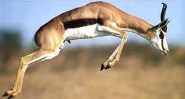
The Springbok (Antidorcas marsupialis) is a type of gazelle found in treeless arid grasslands of southeastern Africa which gets its name from its boastful and magnificent jumping display, called pronking or stotting. It can leap 3.5 meters (11.5 feet) vertically and 15 meters (49 feet) horizontally at speeds of 80 kilometers per hour (50 miles per hour). As it falls from the height of its leap, the springbok expands a flap of skin along the rear half of its back, displaying the white fur under its tail in a fan-like shape. This behavior is thought to attract mates through the secretion of pheromones or possibly intimidate predators. The term for this display, pronking, means "to boast or show off" in Afrikaans.
The Springbok's reddish-tan back and white underbelly are separated by a thick stripe of dark drown fur. They are usually between 70 and 87 centimeters (28 to 34 inches) tall and grow horns about 35 centimeters (14 inches) long. The Springbok can be found in the savannas of northwestern South Africa, throughout the Kalahari Desert in Botswana and Namibia and into southwestern Angola. Well-adapted to its arid habitat, the springbok meets its necessary water intake with the grasses and succulent plants that comprise its diet. As a result, it can survive for years without drinking water, although it will consume water if it can find some. The springbok is hunted primarily by cheetahs, although other animals such as hyenas, lions and leopards occasionally attack the young, old, or sick which are too slow to keep up with the herd.
Springboks travel in herds which are smaller in winter and become larger in summer. However, they are not very social animals in that they groom themselves and rarely touch one another. Females can give birth to a single fawn about every 8 months. Male offspring stay with the female herd until they reach one year of age, at which point they separate into "bachelor" herds. During the reproductive season these herds separate and the males become territorial. Female offspring remain with their mothers until they give birth themselves.
The largest herds of mammals ever witnessed were many kilometers long and consisted of millions of springbok. However, since the springbok has been hunted by man since prehistory, these herds have been greatly diminished. Despite this, the springbok is not considered a threatened or endangered animal and in fact is the only species of antelope with a growing population.
Interesting fact: The Springbok is adopted as a nickname or mascot by South African sports teams, most famously by the national rugby union team.
Monday 25 July 2011
Northern quoll - Single Parent
The Northern quoll (Dasyurus hallucatus) is a marsupial mammal that is native to Australia. It was found from southeast Queensland to the northern Western Australia, but is now manly in the Northern Territory's Top End and other areas north of Brisbane. It is a carnivore and eats reptiles, insects, small mammals and soft fruits. It is also a scavenger and seeks road-kill and garbage tins.
On the IUCN Red List of Threatened Species it is considered endangered. This is mainly because of the cane toad. Cane toads were introduced to Australia in 1935 to control a beetle in the sugar cane fields. They have spread right across Australia and where they flourish, the northern quoll declines. Northern Quolls have also declined because they are hunted by feral cats and because of the changed fire patterns.
Northern quolls weight about 0.525 kg (1.155 lbs) as adults. The males are larger than the females. They are between 240 mm (9.45 in) and 350 mm (13.78 in) long, and the tail is from 210 mm (8.27 in) to 310 mm (12.20 in) long. Both males and females reach maturity at 315 days, but that's where the similarity ends. Almost all males mate at one year and die soon after. The female is left to raise the young herself.
She does not have a typical marsupial pouch, but when it is time to breed in late June the area around her nipples enlarges and becomes a flap of skin. The babies, usually six to seven in a litter, live there for eight to ten weeks. Often two or three babies are lost by September.
Also known as the Northern Native Cat, the northern quoll lives mostly in rocky areas. They like eucalyptus forests that are within 150 km from the coast. The animals that live in the rocky areas tend to live longer than the ones that live on the savannas. They can climb well because of small spikes on their hind feet, but they mostly live on the ground. They are nocturnal, but are sometimes found in hollow logs, rock crevices, hollow trees and caves during the day.
The Northern Quoll has a brownish or dark grey body with white spots. It has a long furry tail like a cat and is a prodigious hunter and will consume anything that moves that is small enough for it to manage.
You can help spreading the word about this animal by liking it on facebook
The Siamang (Hylobates syndactylus) is a gibbon quite similar in looks to a monkey. However, the Siamangs has white cheeks and no tail. The Siamang differs from all other primates because it is a syndactylus, which means that it has two toes on each foot that are webbed. This webbing is between their second and third toes.
They have shaggy black fur and are the largest and darkest species of gibbon. These gibbons have a hairless pouch on their throat that expands when they are vocalizing. This pouch makes them much louder, able to be heard over three kilometers through the jungle. They have large forearms and are very skillful at using their legs and feet to carry things around. These creatures are quick and agile, able to gracefully travel through the treetops.
Siamangs are a bit larger than other gibbons. They are 74 to 89 cm (29 to 35 inches) tall and about 10 - 14 kg (23 - 30 pounds). They live in rain forests in Malaysia, Thailand and the Indonesian island of Sumatra. They don't touch the ground often, staying instead on the tops of trees. They find on leaves, fruits, flowers, insects and bird eggs. They especially like figs.
Siamangs tend not to do well in captivity, they are much too territorial. The fathers and their male offspring defend their territory together. When the Siamangs reach sexual maturity, generally at eight or nine years of age, and partner up, the mated pair sing to one another, composing a unique song that they use to communicate. They are monogamous animals, and the males are active in caring for their young. They dwell together as a family with one male, one female and their offspring. The adults sleep upright with folded arms and their head between their knees.
The Siamang are considered to be endangered. Due to hunting and a loss of their habitat, the Siamang has decreased greatly in number. Fires or destruction of the rainforests have cleared out much of their home. They are also popular with illegal pet traders. These poachers kill the mothers, who are very protective of their babies, and take the infants. Many of these infants unfortunately die during transport.
The Gerenuk (Litocranius walleri) is nature's little acrobat, able to stand upright on its back legs to graze from higher branches. The name actually means "giraffe-necked" in the Somali language. An herbivore, it is a member of the gazelle family.
This delicate mammal received its name because of its long neck and legs. The head is small and wedge-shaped with eyes and ears that are large. The tail is tufted and the body has a reddish color in a saddle shape on the back with cream colored legs, and white underpants. The tail is tipped with black hair, making it easily distinguished from other gazelles. The forehead is typically brown with a distinctive blaze on it. The generuk weighs in at about 100 pounds 45 kilograms. They stand roughly three feet, or .9 meters, tall at the shoulder.
The generuk has the unique ability to stand upright in order to pick the select leaves from higher branches. The lumbar vertebrae are stronger than in other animals. It also has stronger lower limbs and wedge shaped hooves. Its acrobatic balance is so refined that it can actually use its front legs to pull higher branches down within dining range.
Generuks prefer the dry habitat of the desert and the bush of the savanna. It also makes its home in the woodland forests in the region. Found in Kenya, Tanzania, Ethiopia and Somalia it does not require regular supplies of water. It is able to fill its water requirements from the plants it dines on.
Generuks are herbivores and enjoy eating tall bushes, leaves and shoots. They don't dine on grass but do enjoy buds, flowers and fruit of climbing plants. They prefer small groups to large herds and are typically found in groups of 2 to 6 females with one male.
Predators include large cats and wild dogs as well as most other large carnivores native to the area. Specifically, cheetahs, lions and leopards are predators of the generuk. When these animals feel threatened, they stand completely motionless to watch for the danger. Its movable ears are perfect for turning to hear sounds from all around them.
The generuk are not considered endangered, although there is a need to protect the areas in Africa that they are native to. Protecting their habitat can help protect this species as well as countless others.


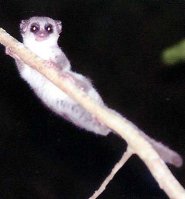 The Fat-tailed Dwarf Lemur (Cheirogaleus medius) lives in the Western and Southern Madagascar areas. The southwest trade winds influence a temperate climate in which the dwarf lemur lives. The areas islands support several lemur varieties including the large lemurs. The fat-tailed dwarf is small in stature and has a fat tail. They are around 6 inches or 15 cm long. The distinctive dark colored rings around their eyes give them the distinctive lemur look. They are a variety of grey and brown colors with a pelage pattern.
  The
The 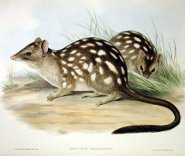 The
The 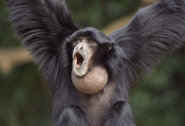 The
The 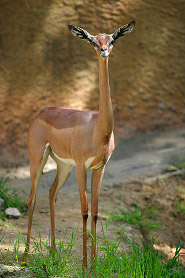 The
The