We hope that reader will gain an increased appreciation of the need for more conservation measure in order to protect the beautiful creatures that inhabit the earth. Our philosophy is that the more we learn about animals, the more we respect them and take better care of them. That is why we update this blog with new animals, We encourage you to syndicate our content by adding "animal of the day" to your own blog! (read more)
About us
Our mission is to get people excited about animals and their welfare by writing articles on these animals. We encourage people to comment on posts and share with others. Don't forget to subscribe to our feed.
The Long-nosed cusimanse (Crossarchus obscurus) can be found in forests and swamps of Africa, particularly Central and Western, also in Liberia, Ivory Coast and Ghana. A Long-nosed cusimanse is a mongoose, its body is thin, with short tail tapers. Long-nosed cusimanses heads are long, with short ears. Just like the other kinds of mongoose, their pupils are oval-shaped, horizontally. Their curved claws are used to catch insects, and the front claws are longer than those at the back. The feet's soles are hairless, the covering (of the body) is brown-grey and they have 36 teeth.
A Long-nosed cusimanse's diet is made up of larvae, small reptiles, berries, fruits and crabs. Foraging, they can come together in sets of up to 20 members. The Long-nosed cusimanse digs in leaves and using the snout, they can move wood. In a way, they are intelligent, for they can crack crab shells against stones.
The long-nosed cusimanse is a sociable creature, they can be found grouped together with up to 24 individuals. One to three families make up their group, each family is made up of a couple plus the newborns. They are in constant movement, not staying at a single place for long periods.
When domesticated, if a female is not mated, she could go into heat up to 9 times annually. In the wild, though, they can produce only two to three litters annually.
Image of the Long nosed cusimanse by LA Dawson, licensed under Creative Commons Attribution 2.5
You can help spreading the word about this animal by liking it on facebook
A Springhare (Pedetes capensis) looks like a kangaroo, because of the long tail, long hind legs and shorter front legs. As its name implies, it is an enthusiastic jumper, and can jump up to 2 meters in a single jump. Technically though, Springhares are rodents, not hares. The head is short and rounded, they have big eyes, with ears that are both upright and narrow.
A Springhare grazes and its diet mainly consists of grass. Every so often, one would eat some roots and leaves, they could also consume wheat and oats. Their natural predators are owls, snakes and jackals. The typical Springhare could give birth all throughout the year, and the female would have 3.6 liters annually on the average. Young are born with hair all over their bodies and it would take at least 3 days before the eyes would open.
Springhares are principally nocturnal but they could be up and about in the daytime too. At day times, they stay in tunnels which they themselves make. Experts have studied that two individuals could reside in many burrows at different times. Actually, they usually form 3 burrows close together forming a circle. A burrow is ordinarily set near the biggest tree.
These rodents are hunted in South Africa, being thought of as a significant food source. In the wild, they could be said to be solitary, but if captured, they could co-exist peacefully.
Interesting fact: They do not drink water, they just get moisture from dew and the rain.
You can help spreading the word about this animal by liking it on facebook
The shrewlike Cuban Solenodon (Solenodon cubanus) has short legs and it possesses skin glands that produce a goat-like smell. Its elongated head has tiny eyes coupled with a flexible snout. Their fur could be any of the following: black, red-brown or dark brown. They could be found in both forests and scrublands, and in the main, they are terrestrial. However, the Cuban Solenodons have the ability to climb. At the ground level, they move with an unsteady gait, but for short lengths, a Cuban Solenodon could run quickly.
At night when they are foraging for food, they use that snout to tear tree trunks. Their diet also consists of snakes, frogs, and crabs. A Cuban Solenodon is basically social, with many members residing in a single hole (burrow that is). A Cuban Solenodon communicates with others via squeaks, squeals and twitte


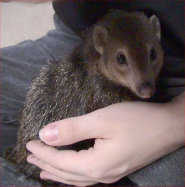 The Long-nosed cusimanse (Crossarchus obscurus) can be found in forests and swamps of Africa, particularly Central and Western, also in Liberia, Ivory Coast and Ghana. A Long-nosed cusimanse is a mongoose, its body is thin, with short tail tapers. Long-nosed cusimanses heads are long, with short ears. Just like the other kinds of mongoose, their pupils are oval-shaped, horizontally. Their curved claws are used to catch insects, and the front claws are longer than those at the back. The feet's soles are hairless, the covering (of the body) is brown-grey and they have 36 teeth.
 A
A 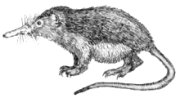 The shrewlike