Monday 31 October 2011
Steppe Polecat - Wild Relative of the Domesticated Ferret
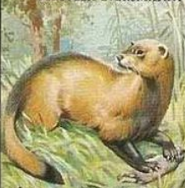
The steppe polecat (
Mustela eversmannii), also called the masked polecat, Eversmann’s polecat or the Siberian polecat, strongly resembles a pet ferret (
Mustela putorious fero.) Although biologists think the European polecat (Mustela putorious) is the direct ancestor of the domesticated ferret because the two species can interbreed, some biologists think that the steppe polecat may also be an ancestor to the pet ferret. Unlike domesticated ferrets, steppe polecats do not come in a variety of coat colors and are hostile to people.
Steppe polecats are found from Eastern Europe to China. Although not listed as threatened or endangered, steppe polecats primarily prey on large rodents like ground squirrels, marmots, water voles and pika. If the habitat for their prey is destroyed, then the steppe polecat will lose a major food supply. Steppe polecats have been observed eating lizards, frogs, willow grouse and grey partridges. Natural predators include birds of prey,
jackals, stray dogs and foxes. Humans also prey on them, trapping steppe polecats for their fur and accidentally kill polecats trying to cross roads.
Physical Description
Steppe polecats grow larger than domesticated ferrets. They average 2 feet (60 cm) in length. Males are larger and heavier than females. One male in the wild grew to 31.5 inches (80 cm), but this is considered unusual. Males tip the scales at 72.31 ounces (2,050 grams) while females only average 47.61 ounces (1,350 grams.)
Steppe polecats possess long weasel-like bodies, short legs and a triangular head. Their bodies are chestnut-brown with a dark dorsal stripe going down the spine to the tail and black feet. Their heads, undersides of the chest and belly are white, but there are dark brown markings over the eyes which make it appear as if the steppe polecat was wearing a bandit’s mask. Their lips and sometimes the tips of their noses are pink. Their winter coat is much thicker and slightly longer than their summer coats.
Life Cycle and Behavior
Steppe polecats prefer to live in grasslands, bases of mountains and arid deserts, but can also make homes in cultivated fields and pastures. They are most active at dusk and dawn. Each steppe polecat has several burrows in its territory. It prefers to commandeer the burrows of ground squirrels rather than dig its own. Each polecat lives by itself. Females keep permanent territories while males have territories overlapping females. The sexes only get together for mating in March and April.
After a gestation of 36 to 43 days, females give birth to one to eighteen kits or baby polecats. They are born blind, deaf and hairless. They stay in their mother’s burrow for two to three months, then come up and begin to learn to hunt. They can take down an adult ground squirrel by the time they are three months old. They soon leave their mother and fend for themselves. Although they can breed sooner, the kits do not become physically mature until they are two years old. It is unknown how old steppe polecats can live in the wild.
You can help spreading the word about this animal by liking it on facebook
Permanent Link
Friday 28 October 2011
The Japanese Macaque - Hot Springs-Loving Similian
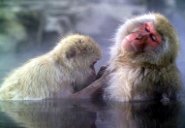
The Japanese macaque (
Macaca fuscata), which is also known as the snow monkey, is famous throughout the world for its love of soaking in hot springs on cold winter days. This very human-like behavior has endeared them to those who have seen images of the little monkeys, their fur covered in snow, peeping out from the steaming water.
Japanese macaques have a naked, red to pinkish face. Its fur ranges in color from brown to gray, and it has a short, approximately three-inch tail. In the winter, the macaques that live in the colder regions grow a thick winter coat. On average, Japanese macaques weigh approximately 18 to 24 pounds (11 kg to 8 kg) and are about 20 to 22 inches (522 to 570 mm) in length. Male Japanese macaques are typically slightly larger than females.
The Japanese macaque can be found on three of Japan's four main islands. The only island they do not live on is the northernmost, Hokkaido. The Japanese macaque lives in a wide range of habitats, from lowlands to mountains to by the ocean. Populations can be found on Shimokita Peninsula on Honshu Island, the Nagano Mountains, by the ocean on Oshima Island, and on the southern island of Yaku-Shima. It is the only monkey that lives as far north of the equator as it does.
These monkeys are omnivores. Their diet typically consists of fruit, leaves and insects. They have also been known to consume crabs, fish and eggs. In northern areas, where the winters can be harsh, the Japanese macaque will feed on bark. Some macaques will wash their food in salt water to both clean and flavor it.
The Japanese macaque are highly sociable animals. They live in troops that are typically made up of about 30 to 40 monkeys, though larger groups have been known to exist. Though these troops do have a dominant male, other male monkeys are allowed to stay in the troops. Female macaques also have a pecking order, with offspring of high-ranking females typically enjoying a high rank in the troop, as well.
The macaque’s now famous habit of soaking in hot springs was first noted in 1963 when one monkey in the Nagano Mountain region ventured into the springs to retrieve an item. Soon, other monkeys followed suit. Nowadays, it is a common practice for the troops in this region to soak in the hot springs. Macaque babies in this region have also been seen creating and playing with snowballs.
Predators of the Japanese macaque include dogs, mountain hawk eagles and humans. Unfortunately, the Japanese macaque is not a shy animal and troops have been known to raid crops on farms and snatch food from children and others. Though they enjoy a protected status, they are occasionally killed by humans angered by their behavior. Loss of habitat has also led to a decline in the Japanese macaque’s population. The Japanese macaque is listed on CITES’s Appendix II, meaning that its trade is monitored and its conservation status is listed as of Least Concern by IUCN.
You can help spreading the word about this animal by liking it on facebook
Permanent Link
Thursday 27 October 2011
Sambar - Water-loving Deer of Southeast Asia
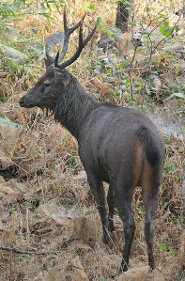
Sambar deer (
Cervus unicolor) are beloved by human sport hunters and by many carnivorous animals still left in the wild. Also called the sambhur deer, fully mature adults can weigh up to 1,200 pounds (546 kg), which is as much as a thoroughbred horse. They grow nearly as tall as horse, too, at 40 to 63 inches tall (102 to 160 cm.) Deer are measured like horses – from the bottom of their hooves to the highest point of their shoulders.
Originally from south and Southeast Asian countries such as India, China, Borneo, Taiwan and Myanmar, herds have been introduced to Australia, New Zealand and three American states, Texas, California and Florida. The deer were introduced solely for the convenience of sport hunters and for gourmands. In the wild, sambar deer are favored prey of lions, tigers, leopards, crocodiles, Southeast Asian wild dogs (dholes) and feral dogs.
General Description
Sambar deer are elk-like in conformation, but sport a longer tail and a shaggy dark mane that stands up when the deer is threatening intruders. They sport a dull grey-brown coat with pale bellies and underneath the tail. Bucks grow a spectacular three-pronged rack that grows about 43 inches (110 cm) long. Adult deer, both does and buck, have a strange hairless red spot mid-way down their throats. Underneath the skin of this spot is a gland that secretes musk.
Sambar deer stamp to communicate to other deer and when danger is present. When really frightened, both adults and fawns can emit high-pitched shrieks. Bucks bellow during the rut but does are quiet. Sambar stags often rub their antlers against tree trunks to mark their territory and may even rear up on their hind legs to do so.
Life and Habits
Sambar deer prefer to live near water. They are not only excellent swimmers, but water can help relieve them of parasites and serve as defense against non-human predators. Smaller predators such as
dholes cannot maneuver in water. Sambar deer have also been found 11,500 feet (3500 meters) up the Himalayan Mountains and snitching illicit snacks out of cultivated fields. Bucks live alone, except during the rut, while females and fawns live in small herds from 2 to 16 individuals.
Does have a gestation lasting seven or eight months. Normally, a single calf is born but twins occur in about 2% of sambar does. Fawns are born with light spots on a chestnut-brown coat, but these spots fade in weeks. They can walk within hours of birth and begin eating solid food at a mere 5 days old. Over the next two months, they transition from milk to an adult diet of twigs, tree bark, leaves, water plants, shrubs, herbs and fruits. Buck calves begin growing antlers when they are one year old. Unlike many other species of deer, calves stay with their mothers for up to 24 months. If lucky, a sambar deer can live nearly 20 years in the wild. The oldest sambar in captivity lived be 38. Sambar deer thrive in captivity.
Picture of the sambar by
Wikigringo, licensed under the
Creative Commons Attribution-Share Alike 2.5 Generic license.
You can help spreading the word about this animal by liking it on facebook
Permanent Link
Wednesday 26 October 2011
Burchell's Zebra - Back from the Brink of Extinction, But for How Long?

Burchell's zebra (Equus burchellii) (and now Equus quagga burchelli) was thought to become extinct in 1918, when the last Burchell's zebra died at the Berlin Zoo. But after many reports came from Africa about sightings of Burchell's, a major expedition in 2004 showed that Burchell's were not only still alive in the wild, but thriving in the areas of Etosha and Kwazulu-Natal.
But all African wildlife is facing a crisis point, including the numerous Burchell's zebra. With constant civil wars, droughts and an exploding human population, zebra meat is in demand and once wild grasslands are rapidly being turned into farmlands. For thousands of years, zebras thrived despite being hunted by
lions, hyenas,
leopards and
African wild dogs. But they may not be able to escape the most ruthless predator of all --
man.
General Description
Burchell's zebras are one of the smallest subspecies, although the mountain zebra (
Equus zebra) is slightly smaller. Like domesticated horses, zebras have their height measured from the bottom of their hooves to the highest point of their shoulders, called the withers. Stallions are usually larger than mares. Stallions can reach heights of 57 inches (145 cm) while mares average 43.3 (110 cm.) Stallions weigh up to 847 pounds (385 kg) while mares tip the scales at 385 pounds (175 kg.)
The four subspecies of zebra are difficult to differentiate. But Burchell's zebras tend to have very pale legs that appear white from a distance. Up close, the stripes are either non-existent or a very faint brownish-grey, depending on the individual. Their bellies tend to be the same color as the legs instead of being striped, although there usually is one black horizontal stripe from the chest to the tail. Burchell's black body stripes are thicker than for other zebra types.
Coloration Controversy
Common sense states that zebras are black and white. But not the Burchell's. Foals are born with distinctly brown fuzz covering their bodies which gradually disappears as they mature. But not all Burchell's grow up into black and white animals. Many sport dark brown stripes as well as black stripes. Some sport thin light brown stripes in between the black and white stripes. Some have distinctly brown patches on their backs, hindquarters and faces.
It was the latter that got some naturalists and scientists wondering if the Burchell's, plains and possibly other zebra varieties normally were brown and black instead of white and black. One extinct species, the quagga, looks amazingly like a modern day zebra with large brown patches and white legs and a pale belly. Attempts to breed a quagga from zebras has resulted in one colt looking remarkably like any of the stuffed quagga still holed up the world's museums.
You can help spreading the word about this animal by liking it on facebook
Permanent Link
Tuesday 25 October 2011
The Greater Kudu - Corkscrew Horned Beauty
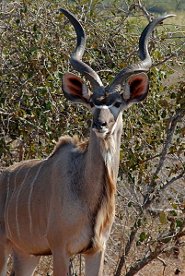
The greater kudu (
Tragelaphus strepsiceros) is a very large and handsome African antelope. The males bear huge spiraling horns that can corkscrew up to three full turns and are arguably, the most spectacular belonging to any antelope in Africa. The average length of a male greater kudu's horns is 48 inches in length, although the largest on record measured 72 inches. Female greater kudus do not have any horns.
Greater kudus are the second tallest antelope in Africa. An adult greater kudu typically stands between four and five feet at the shoulder (100 cm to 160 cm) and can weigh between 264 and 693 pounds (120 to 315 kg). Males are typically about 50 pounds heavier than the females. The coloring of the greater kudu ranges from a reddish brown to taupe to a bluish-gray. The coat on its torso bears approximately six to ten thin, vertical white stripes. The greater kudu's head is marked with a white chevron between its eyes, and it also has small cheek spots. Males greater kudus sport a beard, and both sexes have an upright mane.
The greater kudu can be found in many of the southern countries of Africa, including Zimbabwe, Namibia, Mozambique, Angola, Botswana, South Africa, Swaziland. In east Africa, they can be found in the countries of Djibouti, Sudan, Central African Republic, Eritrea, Ethiopia, Chad, Malawi, the Democratic Republic of the Congo, Kenya, Somalia, Zambia, Uganda and Tanzania. They typically live in scrub woodlands and lightly wooded areas where they can find shelter and where their coloring helps them blend in well with their surroundings.
The greater kudu is a browser that feeds on leaves, vines, flowers and grass. During the dry season, one to three females and their babies will band together for company. In the rainy season, larger groups of up to 20 to 30 greater kudu females may form. Males usually remain solitary, though some do form bachelor groups. During the mating season, males typically try to prove their dominance peacefully with a lateral display in which one male will try to prove to the other he is the bigger animal. Occasionally, male greater kudus will fight for supremacy by battling with their horns. Tragically, the males have been known to accidentally entangle their corkscrewing horns so severely that they cannot get loose and both animals eventually end up dying.
This antelope is a shy animal with large ears that help it hear well. If something frightens it, the greater kudu will bound away in huge leaps. Once it reaches what it believes is safety, it will stop and look back before bounding away again.
Predators of the greater kudu include
lions,
leopards,
spotted hyenas,
cape hunting dogs and
humans. Unfortunately for the greater kudu, its spectacular horns have made it a prized trophy for many hunters, and locals also hunt it for its meat. The greater kudu is not currently regulated by CITES and the IUCN considers them as Least Concern on its list of threatened species.
Picture of the greater kudu by L0k1m0nk33, licensed under
GFDL
You can help spreading the word about this animal by liking it on facebook
Permanent Link
Thursday 20 October 2011
Pacific White-sided Dolphin - Acrobat of the Pacific
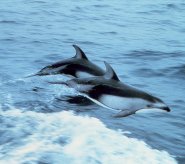
The Pacific white-sided dolphin or “lag” (Lagenorhynchus obliquidens) is a familiar sight to boaters from California to
Korea. They regularly leap out of the water and ride the slipstream of boats. Sometimes they leap high and then flop on the water on their sides, as if purposefully making the largest possible splash that they can. Their intense curiosity about boats makes it difficult for scientists to get an accurate number about how many are left in the wild. Pacific white-sided dolphins tend to and from the same boat. Keeping track of which individual dolphin has already investigated a boat is difficult, since the dolphins look alike.
Most Pacific white-sided dolphins migrate to colder Artic waters off of Russia, Canada and Alaska in the summer and then heads to tropical waters such as Japan or Korea for the winter. But some pods or family groups stay in one area year-round, off the coast of Baja, California and do not seem to mind the winter migraht="31" border="0">
|
|
|
|
|
|
|
|
|
|
|
|
|
|
|