Tuesday 30 August 2011
Gray-backed Sportive Lemur
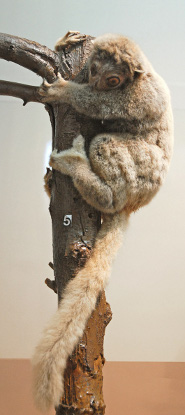
The Gray-backed Sportive Lemur (Lepilemur dorsalis) resides in the country of Madagascar. It a gray with white black in color with a yellowish color belly. This lemur is not very big weighing roughly 1 to 2.5 lbs and their tail is approximately 9.8 to 12 inches (24.8cm - 30.4cm) long. They are able to climb and hang from trees either by their arms or their tails which they curl around a branch like a knot.
'Lemur' means ghost or spirit in latin, and is very appropriate due to their spooky look with their big eyes and little ears. Lemurs reside only in
Madagascar and no other countries and have a very unique and distinctive look.
Almost ninety percent of the rainforest has been destroyed by loggers, endangering the gray-backed sportive lemur's existence as well as all the species of lemurs. Some lemurs are killed by superstitious people who are frightened by their eerie look. Sometimes this species is hunted for food when there is nothing else to eat.
Males live alone in solitude and visit one or more females at night during mating season. Each female will give birth to only one offspring. Once the offspring is born, usually somewhere between September and November, the mother will leave the child on a branch tucked away while they rummage for food. The mother will call to the child sounding like a kiss and the child will make the same sound back so the mother is assured of its safety.
The gray-backed sportive lemur is primarily a leaf-eating species, but will eat fruit and bark to supplement the diet. They possess long tails and binocular vision to focus in on their territory and finding food. The lemur is a nocturnal animal and at night swings vertically from tree limb to tree limb leaping onto branches. The lemur re-ingests its feces which helps to break down the fiber in the leaves they eat. The gray-backed sportive lemur is a very territorial animal.
Picture of the Gray-backed Sportive Lemur by
dalbera, licensed under the Creative Commons
Attribution 2.0 Generic
license.
You can help spreading the word about this animal by liking it on facebook
Permanent Link
Monday 29 August 2011
Tamarisk gerbil - Multi-colored Rodent
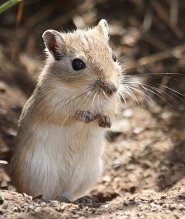
The Tamarisk gerbil (
Meriones unguiculatus) is also known as Mongolian or Tamarisk Jird and also called 'sand rat'. These small burrowing desert rodents have long hind legs used for leaping and running away from predators. They were named by Milne-Edwards.
Tamarisk gerbils normally have 15-18 centimeters (6-7 inches) head measurement, and their furry tails can extend up to 15 centimeters (6 inches) and are bushy towards the tip. These cute animals are preferred pets due to their gentle temperament. These social creatures vary in coat’s color from Yellow to Sandy or Gray or Dark Brown otherwise a classier Golden Agouti, Black, Argente, Lilac, Dove, Sapphire, Silver or Ivory Cream and others.
However, it was not until 1954 when they became popular pets but prior to that they roamed the deserts and steppes of different regions in the world. While these rodents are natural carriers of plagues and diseases, they are kept as pets and used as experimental animals. Like the Hamster, they are used for research or scientific testing.
These animals are abundant everywhere from the Mongolian desert, to the
Russian Federation,
Kazakhstan,
Kyrgyzstan,
Tajikistan,
Turkmenistan,
Uzbekistan and also in
China. However, while considered rare in some areas they are not definitely considered endangered. However, the possibility of extinction may depend greatly on habitat degradation, water loss or droughts and least likely on human disturbance.
These animals do not usually grow in colonies but normally live in family groups. The female gerbil usually gives birth up to 3 times per year. They thrive on
grassland, scrublands,
desert, plantation and terrestrial areas. They survive on cold and dry winters and also on hot summers. Those family groups of gerbils who live in deserts may grow in extinction due to trampling of camels and other large animals.
These intelligent mammals live in burrows with around 10-20 exits. These exits provide a way of escape for their common predators like snakes and birds of prey. Tamarisk gerbils in the wild feed on seeds and vegetation, domesticated gerbils on the other hand may be fed with food mix usually labeled as hamster and gerbil food.
You can help spreading the word about this animal by liking it on facebook
Permanent Link
Tuesday 23 August 2011
California Condor - Wearing its Heart on its Sleeve
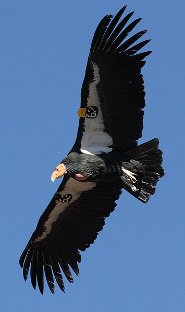
The California condor (
Gymnogyps californianus) is among the largest of the world's flying birds. They will fly as far as 150 miles a day in search of food. These birds have a lifespan of up to 60 years, making it one of the longest-living birds ever. They are often found near large, tall trees or cliffs, where they can build their nests.
These distinctive vultures have very long necks and bald heads, allowing them to feed within a carcass. Bodily fluids will not get stuck to them due to the way they are built. When they need to keep warm, they can tuck their heads into their fluffy, feathery collars. Amazingly, the skin color of these birds change depending on their emotions. The colors can vary from yellow to a neon-green to a glowing red-orange, to even a purplish-blue.
California condors scavenge for food and will often remain high in the air, circling around a newly found meal to signal to other condors that it is time to eat. They feed primarily on carrion, and will search for miles to find it. Besides
human beings (via hunting), the condors major predators include eagles, coyotes, snakes and mountain lions. These animals primarily attack young condors or eat condor eggs
The average weight of the California condor is 8 to 13 kilograms (18 to 29 pounds). Their wingspan can be nearly 3 meters wide, or 9.5 feet, the largest wingspan of any other bird in North America. These birds mate for life and lay one egg every two years.
The California condor resides in the mountains of south-central California, the Grand Canyon and Zion National Park. California condors are on the critically endangered list. There are only about 400 of these birds left on the planet, including the nearly 200 that are in the wild. When they became extinct in the wild, a captive breeding program began to keep them alive. The condor chicks who are born into captivity are fed with a condor hand puppet, making sure they don't become to attacked to their human caretakers.
You can help spreading the word about this animal by liking it on facebook
Permanent Link
Tuesday 16 August 2011
Cotton-top Tamarin - Rock Star of the Forest
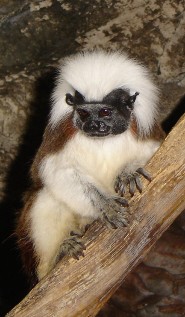
The Cotton-top tamarin (
Saguinus Oedipus) is a New World monkey that is native to the humid and dry deciduous forests of northern
Columbia. This little monkey is instantly recognizable for the shock of white hair on top of its head that falls back over its shoulders, making it look like an aging rock star or an eccentric mad scientist.
The Cotton-top is a barefaced tamarin, so characterized because the facial hair is fine and short and makes the animal appear to have a hairless face. Below the white crest hair on the head, the animals have a mottled gray-brown coat on their shoulders, back and rump, white limbs, and reddish patches on the inner thighs. The average height for both males and females in the wild is 23.2 centimeters (9.13 inches), including the tail, with an average weight of 450 grams (15.9 ounces).
The habitat of the Cotton-top is between the understory and the canopy of the tropical forests, where they forage for insects, fruit and plant exudates (tree sap and gum). Cotton-tops require a high-energy diet due to their diminutive size and fast metabolisms, and they play an important ecological role as being a highly efficient seed-disperser in their tropical ecosystem.
The Cotton-top tamarin is a highly social animal, and they live in cohesive groups of up to a dozen individuals that are usually headed by a dominant breeding female. Care of the young in the group seems to be a shared responsibility, with mothers, siblings and unrelated adult males taking turns carrying and grooming infants and young. Cotton-tops also have a highly developed system of vocal communication, using whistles, chirps, hoots and staccato long calls. Researchers have identified 38 distinct calls that appear to conform to grammatical rules.
The range of the Cotton-topped tamarin in the wild has been greatly reduced due loss of habitat through deforestation, and is now limited the remnant and secondary-growth forests of northern Columbia. The wild population was also severely impacted by the capture and export of tamarins for medical research and the pet trade through the 1970s. Today the wild population of the Cotton-topped tamarin is estimated to be less than 6,000 individuals, and the species is listed as one of the world’s 25 Most Endangered Primates.
You can help spreading the word about this animal by liking it on facebook
Permanent Link
Monday 15 August 2011
Bongo - World's Largest Forest Antelope
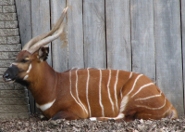
The Bongo (
Tragelaphus eurycerus) is an antelope species that can be found in certain parts of Africa. The Bongo is the heaviest and largest forest antelope. The animal is usually reddish orange in color with about 10-15 distinct vertical white stripes. The coat color will grow darker as the animal ages. The animal has a black muzzle with a white cheek spots.
One of the unique features of the Bongo antelope is that it is one of only animal species in the world where horns can be found on both male and female sexes. The Bongo's horns can grow up to 75-100 cm long and can be a bit wavy in appearance. Horns of females are usually longer, thinner and more parallel.
Dimensions
Length: 5.6-8.3 ft. or 170-250 cm
Shoulder Height- 3.6 to 4.3 ft. or 110-130 cm
Tail Length- 18 to 26 in. or 45 to 65 cm
Weight- 525 to 880 lb. or 240 to 400 kg
Animal Behavior
The Bongo is a solitary and shy animal that usually move in singles or small pair groups. An average sized group may consist of about 9 or less females with their young. If startled, the Bongo will quickly flee into the forest. When running, Bongo horns are held back to prevent them from tangling with the vegetation. Bongos are also nocturnal animals that are mostly active between dusk and dawn. The animal loves to polish their horns, wallow in the mud and rub themselves against the tree. Their vocalizations include snorts, grunts, a moo-like call and a bleat-like call used when alarmed. The main predators of the Bongo are men and leopards.
Habitat
Bongos can be found in the dense African forests or jungles with altitudes of about 4,000 meters of central Africa. There is a little population in Kenya and some other West
African countries. Countries where Bongos live include Cameroon, Burkina Faso, Congo, DRC, Equatorial Guinea, Gabon, Guinea, Ghana, Mali, Sierra Leone, Liberia, Ethiopia, Cote d'Ivoire, Sudan, Niger and Guinea-Bissau. Kenya is the only country where the animal can be found in the wild.
Diet
Bongos are herbivores and their diet consist of bushes, trees, barks, vines, rotting trees, herbs, grasses, cereals, fruits, shrubs and roots. As nocturnal animals they usually graze during the night. The animal has a prehensile tongue that allows it feed off easily from high vegetations.
At present, the Bongo is regarded as a threatened animal with dwindling numbers. Deforestation and hunting has greatly reduced their numbers. The animal is already reportedly considered to have gone extinct in three African countries, which are
Uganda,
Togo and
Benin.
You can help spreading the word about this animal by liking it on facebook
Permanent Link
Friday 12 August 2011
The Calabar Anwantibo - Nature's Hanging Lover
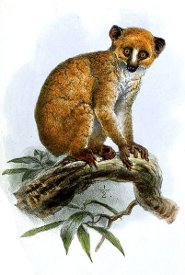
The Calabar angwantibo (
Arctocebus calabarensis) is sometimes called the Calabar potto due to its close relation with the Pereodictus potto. The animal is classified as a strepsirrhine primate of the Lorisidae family. The animal can be found in the rain forests of west Africa, covering a range of
Cameroon,
Nigeria and
Equatorial Guinea.
Orangish-yellow on its back with grey or white fur on its belly, the primate has a white line traveling from the tip of its nose to its forehead. With his wide, round eyes, the Calabar angwantibo is a beautifully startling animal to look at. The animal has a very short index finger which makes it easy to grip branches and a second toe with a specialized claw which is used for self-grooming. Interestingly, the Calabar angwantibo is the only primate in the world to have a third eyelid (nictating membrane)tBefore(ga, s);
})();

