Tuesday 28 August 2007
Giant otter
As its name indicates, the
giant otter (
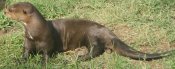
Pteronura brasiliensis) is the largest otter in the world. Its body length can reach up to 1.4 m while its tail alone can grow to be 30 cm to 100 cm. The average weight of an adult giant otter can reach up to 34 kgs. The males are larger than the females.
The giant otter's feet have been adapted for their amphibious life. They have strong claws and big webbed feet, and its under-fur is water-repellent. The giant otter is extremely dark brown, almost black in color, except for a distinctive white spot at the throat's area. The giant otter lives in the larger rivers of the tropical rainforests in South America, preferring the slower rivers where vegetation is thick at the banks. To avoid their predators, the puma and jaguar, giant otters avoid bare ground, when possible, and prefer to live in areas with a large amount of vegetation.
In the past, the giant otter’s range was from Venezuela to northern Argentina; however, currently they are found only in Guyana and Brazil. Giant otters are social and live in groups, called holts. The holts are territorial. A giant otter holt consists of family members, typically siblings. The entire holt will help to rear the young and defend their territory.
Giant otters subsist primarily on fish, particularly catfish and perch. However, on occasions when fish is scarce, they will eat crustaceans, caiman and even snakes.
Interesting fact: This otter is able to eat six to nine pounds of food in a single day.
Picture of the Giant otter by Renaud d'Avout d'Auerstaedt (
http://renaud.davout.org/), licensed under
Attribution ShareAlike 2.5
You can help spreading the word about this animal by liking it on facebook
Permanent Link
Sunday 26 August 2007
Short-beaked Echidna - The Spiny Anteater
The
short-beaked Echidna (
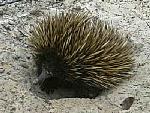
Tachyglossus aculeatus) is one of four living species of Echidna (The Cyclops Long-beaked Echidna was recently discovered). It regularly eats ants and termites, therefore its nickname, the spiny anteater. It inhabits most of Australia and many nearby islands including Tasmania and New Guinea. They generally use their smell to locate food. Some scientists believe they can receive electric impulses using sensors around their nose to help them in locating prey animals.
You can help spreading the word about this animal by liking it on facebook
Permanent Link
Sunday 19 August 2007
Meerkat
The
Meerkat (
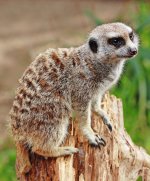
Suricata suricatta) is a member of the mongoose family. It can be found in the Kalahari desert in the South of Africa in Botswana, Zimbabwe and Mozambique, where it lives in so-called 'mobs' or 'gangs'. Their tails are, unlike other mongoose species, long and thin instead of bushy and has a black / red tip. They use their tail for balance and use it to look larger than they really are when threatened or when mobbing, in additon they arch their backs. They are very social animals, and can live together with 3 families, and as much as 30 individuals. Among packs heavy competition and fights can arise. Packs work with sentinels, which sound the alarm with their distinctive bark. Male meerkats tend to take over or emigrate to another pack when they become adults. Their main diet consists of insects, but they will also eat small invertebrates, eggs, reptiles and birds. They are not endangered or threatened.
Interesting fact: The color of the coat of the Meerkat differs per region, following Gloger's rule, which, in short, is that animals living in more humid areas have darker coloured coats than their relatives from more arid regions.
Image by Fir0002, licensed under GFDL
You can help spreading the word about this animal by liking it on facebook
Permanent Link
|
|
|
|

